Yesterday was the worst day for weather since I arrived here in early July. That day was the first day of snow in Buenos Aires since 1918. What better way to enjoy miserable weather than taking a ferry boat ride to another country?
Colonia del Sacramento is the oldest town in Uruguay, a World Heritage site, and only one hour away across the Rio de la Plata, so it was high on our list of must-sees.
As I walked through the cold, dark, wet streets yesterday morning, my half-broken umbrella flapping in the wind, I did wonder if this was a good idea.
However, I didn't want to disappoint my colleagues by staying home. Perhaps it would get better later.
The ferry terminal was only a few minutes walk away, and we arrived in plenty of time (for any normal ferry terminal). I failed to allow for the comic opera of life in Argentina.
First, we couldn't pre-purchase the tickets because they had to see our passports. Then we had to take the vouchers to the cashier's desk to pay. Then we got our tickets. At this point we queued for security, got through the x-ray and found out we also needed boarding passes. Boarding passes obtained, we were directed out of the building and back onto the street. Why? Because that was where the courtesy bus was parked. This is the first ferry terminal I have ever seen where you drive off somewhere else once you have checked-in.
The ferry ride was uneventful - so uneventful that my colleagues (who had been up late the night before), dozed off as we cast off and didn't move until we docked at Colonia at about 10:00.
Any hope that the weather would be better on the eastern side of the Rio del Plata was swiftly dashed. It was worse. Rain, wind and gloom. No mud, but plenty of slippery cobblestones. We called a taxi for the short ride to the centre of Colonia and got out to enjoy the World Heritage site.
No question Colonia is very pretty. I could easily imagine the happy porteños crowding the cobbled streets and beaches in the summer time. This day, everybody appeared to be huddled inside trying to get warm.
By 10:30 we retreated to find coffee and toasted sandwiches, and tried to work what to do next to keep our blood circulating. It was too early on a Sunday for anything interesting to be open.
We had heard from one of the taxi drivers that Colonia had just opened a mall (yes, pathetic, but we were very cold), so we drove there. The mall turned out to be roughly the size of an Olympic swimming pool, so twenty minutes exhausted its recreational possibilities.
The next taxi driver had heating and turned out to be a well-informed local, so we adopted him as our impromptu tour guide.  He took us to see the famous Colonia bull ring - built in 1910, used 8 times and closed in 1912. He also showed us where Diego Maradona used to live, and where people go to the beach in summer.
We spent another hour or so touring the town's two small museums.
The museum of colonial history is in a historic and partly-restored house. They have some interesting 18thC documents regarding the early history of Colonia, though stored in poor environmental conditions, and quite badly foxed. Donations for a climate-controlled case are recommended.
The indigenous museum is also entertaining, particularly for small, round rocks, of which they have a large collection.
By now it was lunchtime, and a cozy restaurant with hot food seemed very appealing. We made our way to a big stone tower on the waterfront that served approximate Italian. I can't remember the name, and I can't find a review to check. We ate on the second floor of the tower, looking out at the rain blowing across the big brown river. We ordered soup to start - the tower was cold enough we could see our breaths, and we needed the warmth. I know there is an energy crisis across the river, but it was less than 10 degrees in there.
It took me three attempts and nearly an hour to get my main course - first they confessed that they ran out of gnocchi, then they brought the alternative pasta with the wrong sauce. It seems that "quatras quesos" sounds just like "portuguezas" in Uruguayan Spanish. When the food did arrive though, it was good.
At 15:00 it was time to return to the ferry terminal. Everything ran smoothly through the rather eccentric emigration process, up until the point where our US colleague was detained at the border. We thought perhaps the United States had been behaving badly in Uruguay, but no, he did not have a stamped copy of his original boarding pass from the morning. Some arguments in Spanish later, he was grudgingly allowed to leave Colonia. He really didn't seem to enjoy the next twenty minutes of jokes about being detained in an immigration lockup until we sent a consul from Buenos Aires to rescue him. I just counted my blessings nobody asked me - the morning's boarding pass was one of the many soggy bits of paper that blew away during the course of the day.
By this time we were a little paranoid about what would await us going back into Argentina. The answer was - nothing... I suppose if you are getting on a vessel that only goes one place, there isn't much point in doing immigration at both ends.
It was only back in Buenos Aires, as we walked back toward the hotel, that the others confessed to their own second thoughts about the weather. If we had all been a little more selfish, we could have slept in! All in all though, it was a fun day out, and I'm looking forward to going back when the sun is shining.
Of course this Monday morning we awoke to a perfect cloudless sky. Curse the weather gods for their sense of humour.
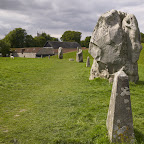 London Walks again came through on walk #4 (see the list of London Walks). In an eerie coincidence, they offered a day trip to Avebury and Lacock on the very day I was struggling to figure out a means of getting there by public transport. As usual, the cost was low, the organisation flawless and the guide whimsical.